By Jim Nelson | August 11, 2025
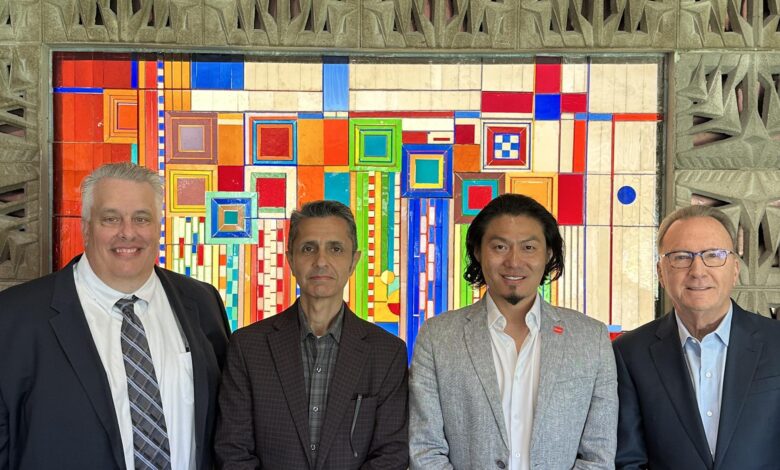
Hospitality Events producer BITAC recently gathered casino executives from across the nation for its annual Casino Resorts event. One of the panel discussions explored casino resort design from three different angles. Moderated by Hogan Chun, Gensler‘s southwest regional hospitality leader, the panel aimed to understand the historical trajectory and current trends shaping casino resort architecture and guest experience.

The panelists were Bill Smith, senior vice president of design and construction at Shopoff Realty Investments; Jeff Carstensen, the COO/CFO of Rolling Hills Casino and Resort; and Emile Aboona, Co-founder/COO at Q&A Hospitality Services, a design/procurement/installation firm.
“The first question is about looking back,” said Chun. “What were the defining characteristics of casino resort design in the early 2000s, and how have they shifted over time?”
“If you look back in Las Vegas,” responded Shopoff Realty’s Smith. “Steve Wynn kicked off, in 1989, the first themed resort. I call the following decade ‘The Decade of Themed Resorts,’ because we built nine more casinos from when Steve opened in ’89 to 2000, and they included Bill Bennett’s Excalibur; MGM Grand, which was themed after their theme park and their movie studio in L.A.; New York-New York was built in that same time frame; Paris was built in that same time frame; and toward the end of that was Steve Wynn’s Bellagio, which was themed. It may not look as themed as New York-New York with the roller coaster, but it was themed after Lake Como; I worked for Steve during that project. And then, when you look in after 1999 when Paris opened, you see things move toward a luxury role. You see Wynn opening in 2005, you see the Encore (Resort) opening in 2008, you see CityCenter (now called Aria Resort and Casino) opening in 2009, and eventually Cosmo (The Cosmopolitan of Las Vegas) the following year. But again, we were not into themes. So, Steve Wynn, 1989 to 2000 fully themed, to more of a luxury role that we have right now, the most recent one being the Fontainebleau, which you could say is somewhat themed because they are bringing Miami to that property, but that was really the trend. So, we had one decade of really heavy theming, and now we’re more toward the luxury side.”
“Regionally, it was, ‘Slot machines, people will come,’” said Carstensen of Rolling Hills Casino and Resort. “Now it’s more, ‘What are the amenities?’ It’s the concerts, the hotels, the food, all the different aspects of it. What can you do to try to entice them to come more often to your property?”
Influential Factors in Design Evolution

“What have been the most influential factors — economic, cultural, or even technological — in driving design evolution in the casino resort industry?” Chun asked next.
“For me — and I’ll use the dream hotel that we just designed — it’s really technology,” replied Smith. “What we’re able to do today with our phones and download speeds and upload speeds, it’s really important. You look at some of these older resorts, look at many of them along the strip, they don’t have the capabilities. Making sure that the dream has what is needed to deliver on the technology, we have two 100-gig fibers coming into the building so that we can really distribute it over the building, the speeds that we need; looking at our heat maps, making sure that when you’re on the pool deck you have really good service. A lot of times it’s great on the podium, somewhat marginal in the tower, and not so good on the pool. So, making sure that we are delivering on the high-speed network systems that are needed today.”
“Things that are not visible to the human eye, especially when it’s well-integrated Wi-Fi and things like that, could really affect a guest experience,” Chun added. “We all know that as soon as you lose connectivity, you start panicking and things go out the window, and that aspect of a seamless guest experience has a lot to do with that Wi-Fi. So, that’s a great perspective.”
“Technology, definitely,” added Carstensen. “At our property, in the last four or five years, we actually have cashless gaming — you don’t even need to bring cash to the casino anymore — it just downloads from your phone right to the game.
“One of the restaurants we have, we actually had it closed for about three, four months,” Carstensen continued, “but we have robots, so we opened back up with one bartender, two cooks, and the robot; it makes it profitable … basically, the bartender never has to go to the kitchen; the order comes out and the robot brings it to a spot; then a person brings it to [the guests].”
Global Standards vs. Regional Differentiation
“How does casino design in Las Vegas compare with emerging markets like Asia, the Middle East, or Latin America,” Chun wondered, “and are we seeing global standards or more regional and local differentiation?”
“I think it’s more regional,” replied Smith. “Just compare Macau to Las Vegas. If you look at Aria, we have 160,000 square feet of gaming. If you go to The Venetian Macau, it’s 400,000 square feet of gaming. The ratio of slots and tables is completely different in Las Vegas; if you go along the strip, 67 percent of the properties have slot machines; that’s the ratio against table games. In Macau, it’s 35 percent because they have this large number of people; they have 600 table games at The Venetian in Macau and 2,000 slots, so the ratio is much lower than in Vegas. Part of that is driven [by] a real desire to play the table games in Asia, and they certainly have the population that supports all that; you go there on a Friday night, you can see three to four people standing in line behind each of the tables, waiting to play. So, [it’s a] really different gaming layout and demand based on the customers.”
“So, it’s really about knowing your audience and your market and being able to deliver on that,” Chun commented.
“The regionals [are] very defined,” added Carstensen. “When you go to Vegas, it’s maybe spread out. They have four or five different pits here or there, and you get lost in them. And I think the regionals keep everything flowed right through, so you don’t get as lost; you know where everything is, so when you come back the next time you can go right back to that machine.”
“From our perspective,” said Aboona of Q&A Hospitality Services, “you look at region by region and where you use a characteristic of that region for artwork. For example, if you’re in Indianapolis, [use an] indie-theme, racing.”
Case Examples: Design Evolution in Action
 “The last question is about case examples,” Chun changed course. “It’s about sharing a project that you may have worked on that you feel best illustrates the design evolution in action. Are there any projects that come to mind?”
“I would compare Bellagio to Aria,” Smith shared. “If you look at Bellagio again, slightly themed like Lake Como, but you look at the interior design that Roger Thomas put together, who is our in-house interior designer — he also did the Wynn and Encore — if you look at the canopies over the gaming tables, [you see] lots of fabric, lots of materials; if you move over to Aria, which is a different design, it’s not themed, it’s really about metals and woods and more interior design that fits the overall concept for Aria that the setup over those tables are completely different. It’s a selection of wood members that are dark, that carry the casino lighting, also includes all the security cameras that are needed. So, a completely different approach on the design of the canopies overlooking the gaming.”
“When I was in Oregon,” Carstensen answered. “We wanted to start diversifying for the tribe, so we built a travel center 15 miles away and we added slot machines; it actually had its own gaming [that] had to be class two, because in Oregon you are only allowed one class three. But the thing is, the machines were almost doing better there than down at the regular property, because it was closer to the town, it generated more revenue; the machines were doing very well — a lot better than I thought. They’re actually doubling the size of that, [they] took the restaurant out because of the demand that’s there now. Now, instead of having 30 [slot machines], they’re going to have 60 or 70. It’s almost like a mini casino now.”
“I’ll use the two projects for Spokane Tribes of Indians, where they had engaged a design firm out of L.A. and they brought us to the table,” Aboona replied. “There is no brand approval; you go straight to leadership of the tribe. And things were approved fast: We had their budget, we made our selections, we chose the manufacturers; one is in Mistequa, one is in Airway Heights (Washington). They opened, they were great, and we take a lot of pride in that, because those are feathers in our caps, and that’s what opened up doors for us with Wild Rose casino, and now we’re on the RFP for, hopefully, Bally’s in Chicago. Casinos was not something that we were involved in; we came through word-of-mouth recommendation, and we’re so glad that happened.”
Future Trends
“What are you guys seeing that you think really is driving casino resort design?” asked an audience member.
“I think it’s just going to be more technology,” added Carstensen. “Phone to machine, cashless. I think that’s just going to be bigger and bigger, more technology, with AI and all that. How can we control it?”
“Because of the F1,” Smith added, “there’s also a developer talking about building a tower similar to the ones down in Florida, the Porsche Design Tower and some of the others, where you’ll be able to park your car, take it up via elevator and have it at your unit. F1 has prompted a new brand of development.”