May 29, 2026 | From the Hotel Interactive Newsroom
SCOTTSDALE, Ariz. — Hospitality executives converged May 17-19 at the Scottsdale Resort in Scottsdale, Ariz., for the 2026 BITAC Owners spring event, where the Day 1 session focused on “The New Hotel Owner Playbook: What Actually Creates Value in 2026?”
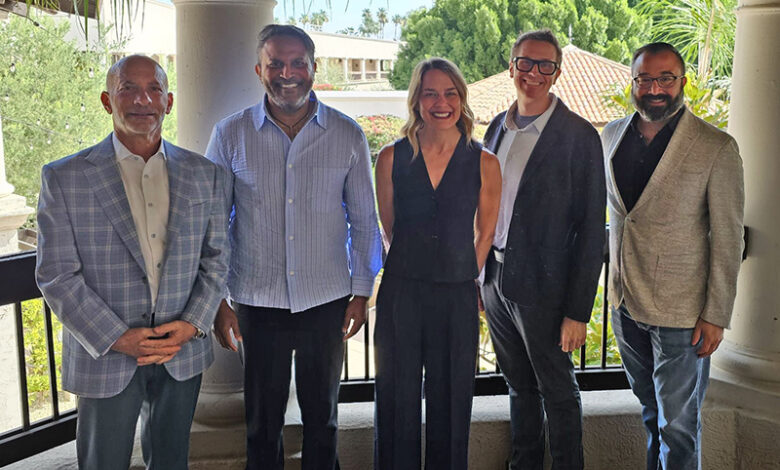
Moderating the session was Sondra Storm, principal of Embarcadero Hospitality Group, who brought a background in urban planning, boutique hotel development and public-private consulting. Joining her on stage were:
- Bryan Fish, CEO of Reliance Hospitality;
- Ted Jabara, senior vice president of Meyer Jabara Hotels;
- Jean Makesh, managing director of K7 Capital Partners; and
- Ron Pohl, president of WorldHotels and president of international operations for BWH Hotels.
To open the discussion, Storm laid out the current ownership environment: The cost structure of hotel ownership has shifted — labor, debt and capital constraints have made the business less forgiving — and performance is increasingly tied to factors outside the building itself.
“Generic hotels have less pricing power,” she said, “and performance is increasingly tied to what surrounds the asset, not just what is in the hotel.” For owners, she said, that means getting the fundamentals right from the beginning.
‘We’re Not Just Selling Hotel Rooms’
Thinking outside the hotel room requires rethinking hotel ownership, which is no longer just a room-selling business. Makesh, whose firm K7 Capital Partners shifted to mixed-use development after the pandemic-related disruptions of 2020, described the hotel as essential infrastructure within a larger ecosystem — a catalyst for surrounding real estate rather than a standalone asset.
Before 2020, he said, his company developed senior housing, hotels, retail, multifamily apartments and other uses as separate, single-use assets. After seeing those assets take hits at the same time, he said the company shifted toward mixed-use development.
“We decided that we got to control our own ecosystem,” Makesh said. “We got to do something where every single asset that we have is dependent on each other to thrive.”
Storm expanded on that point, noting the shift requires owners to look beyond the property itself and consider how the hotel connects to the surrounding market and the businesses, events and amenities that help drive demand.
Jabara added that view is central to how Meyer Jabara Hotels evaluates assets and development projects.
“While we’re in the hotel business, we are certainly not in the business of selling hotel rooms,” Jabara said. “So, when we look at our assets and different development projects, it is really important to us to take a holistic view.”
He pointed to the hotel hosting the conference as an example — noting that on a Sunday night when the property typically runs around 50% occupancy, it was at 80%, driven by eight groups of golfers attracted through a strategic partnership with an adjacent golf course the hotel does not own. “They looked at their street corner and said, ‘How do we really weave this thread and create an experience for our customers, as opposed to sell them a hotel room?’”
Pohl said that while experiential travel remains a major topic across the industry, he cautions that owners need to understand how differently that concept can apply across markets and guest segments. “We have to understand that we have five generations of travelers today,” Pohl said. “We all too often try to bucket them and say millennials want this and Gen Z want that.”
Those assumptions, he said, can break down quickly because travelers within the same generation often have different expectations.
“As we look at the hotels in the areas, we really need to understand what is the drive there, what should that hotel reflect, and what type of experience is it going to provide based on those different demographics,” Pohl said.
Storm offered an example from her own portfolio, explaining how EHG’s wine country properties work closely with regional wine organizations on event scheduling. In one case, that collaboration helped move a festival from July, when her hotels were already full, to February, creating demand during a slower period.
“Those active community partnerships,” she said, make a measurable difference.
Execution and Human Capital
While strong community ties and strategic partnerships lay the groundwork, sustaining that performance over time brings its own set of challenges, which the panelists examined as they discussed the difference between high-performing and underperforming assets.
Jabara said that after development and opening, performance often comes down to people and discipline. “People are what make our business, and we’re in the people business, so the better the people, the better the business is going to be,” he said.
“Where we see it is really the gap isn’t strategy, it’s the execution of discipline,” Jabara said. “If we’re using an old playbook, if we’re using legacy habits, [we’re] sunk.”
At Meyer Jabara Hotels, that discipline extends to financial transparency. Jabara said every level of the organization — including executive housekeepers — has access to a filtered version of the P&L and is taught to read it.
“We believe if we are going to be successful holistically, everyone’s got to be marching to the same direction,” he said.
Fish agreed that financial visibility can help hotel teams understand the asset beyond their individual departments.
“I’m still shocked [at] how many organizations don’t share their financial data with their teams at their hotels,” Fish said. “It’s a real estate asset; you’re not just playing hotel at the end of the day.”
He added that sharing that information can create stronger buy-in from when a property needs to adjust expenses.
Storm added that her firm’s venture capital partners have made a habit of quizzing team members on the property’s top priorities. “It is a great thing to empower the team and give them all the information.”
Spending, Data and Technology
Storm turned next to what owners are still spending money on that no longer creates meaningful value. Pohl said the answer depends heavily on the project.
“Every project is so different today that you have to do the market research, you have to understand the demographics that’s coming to that area, you have to understand that environment and build to that,” Pohl said.
He cautioned against owners relying too heavily on a fixed vision for a property when market data may point in another direction. “It’s very easy to ignore what the data is telling you when you’re trying to build that project.”
Pohl also said owners should be cautious about trying to build complex technology, loyalty and web infrastructure on their own.
“Don’t try to do it on your own,” Pohl said. “Tie into a loyalty program. Tie into a partner … tie into those that are experts on website development, because with AI now entering everything we’re doing, that matters.”
He also pointed out that consumer search behavior is already changing and owners need to understand how their hotels appear in AI-driven search results.
The Cost of Deferred Thinking
Fish raised what he characterized as a widening disconnect between owner expectations and operational reality — one with significant capital consequences.
Fish said owners may still want returns that were more realistic a decade ago, while operators are dealing with higher costs and day-to-day pressure to deliver results.
“Labor is not getting any cheaper,” Fish said. “The reality is the cost of pretty much anything that you need to do at the hotel is not getting cheaper.”
He said third-party operators can become too focused on short-term bottom-line performance while neglecting long-term asset protection. The result is owners facing expensive capital projects that could have been avoided.
Fish cited guestroom bathrooms as a common example of how deferred maintenance can become a much larger capital expense. If a failed exhaust motor goes unaddressed — potentially a $700 fix — moisture can spread through the bathroom and into the room, turning what may have been a relatively small repair into a full bathroom renovation that costs thousands of dollars per key. “In three years, you’re gonna be [mad] at me when I tell you that you’re gonna have to write a check for $10 million on a Hampton Inn.”
Jabara said that point has pushed his company to train general managers to think more like asset managers.
“How do you think like an asset manager, right? And how do you train your GMs to think like asset managers?” Jabara said.
Jabara said Meyer Jabara Hotels has addressed this by training general managers to think like asset managers with capital planning horizons that extend two to five years out. The payoff showed up during a recent property-improvement-plan negotiation for a 300-plus-room full-service property undergoing a 21-year relicense refresh.
Measuring the Experience
As the discussion returned to the role of experience, Makesh drew on his background as an occupational therapist and his work with Alzheimer’s patients.
The last memory to fade in dementia, he noted, is emotional memory — and that realization reshaped how he thinks about hospitality and mixed-use development.
“Can I create an emotional relevance, an emotional memory, for my clients? My guests?” he said. “Are we able to serve different cultures across demographics?”
He said he found that if he can create lasting emotional memories — rather than generic “experiences” — then he can support substantially higher room rates and stronger margins without relying solely on traditional pricing models.
Fish cautioned that “experience” has become overused in hospitality and can be used too broadly to justify capital spending.
“The experience doesn’t necessarily need to be something new that’s added, it’s just delivering what you were supposed to deliver in the first place,” Fish said.
He said owners need to understand the actual customer at each hotel, rather than assume that every amenity or service decision applies across brands and segments.
“A lot of it, when it comes to experience, is just delivering what’s important to that guest at that hotel,” Fish said. “It’s not about adding something else to the mix.”
Jabara said experience begins with human programming and brand discipline. He cited a 16-room independent boutique hotel in Greenport, N.Y., as an example of a property that built a clearly defined guest experience. The hotel has received a Michelin Key for the second year in a row. He explained that the team went through a series of branding exercises that eventually translated into pricing power.
“If you go all in, and if this is what you’re passionate about, if you’re passionate about building a brand and protecting it, you can almost always make that a differentiator, which is going to have a clear and tangible return on the bottom line,” Jabara said.
Pohl offered a larger-scale example, pointing to Caribe Royale Orlando, a WorldHotels property with 1,300 keys, where the owner-operator invested in turning a bar area into a sports venue with screens, indoor golf and racing.
“They’re making more than a million dollars a year on that now that it’s completed,” Pohl said. “They’re now attracting groups that they never could before.”
Finding the Money
The panel closed with a discussion of how developers can improve their capital stacks by engaging more aggressively with public incentives — grants, tax deferrals and other municipal tools that, the panelists agreed, go unclaimed far too often.
Makesh estimated that on a $20 million project, developers may be leaving close to 10% on the table by not pursuing available incentives. “There’s so much free money,” he said, “and I didn’t know that.”
Storm noted that her firm recently secured a $10 million contribution through a transient lodging tax rebate that made a deal viable. She also works on the public side — consulting for cities and ports negotiating with developers — and said the alignment of interests is often stronger than owners assume.
She closed with a data point she said resonates with municipalities: An Oxford Economics study found that for every dollar spent at a hotel, $1.21 circulates in the surrounding community, not counting transportation or gaming. “Those are really powerful numbers to share with communities,” Storm said, “and they often want a hotel.”
***
Interested in speaking at a future event? To learn more about speaking opportunities, connect with the BITAC team here.
Follow BITAC Events on LinkedIn, Instagram and TikTok for event updates and highlights.