June 12, 2026 | From the Hotel Interactive Newsroom
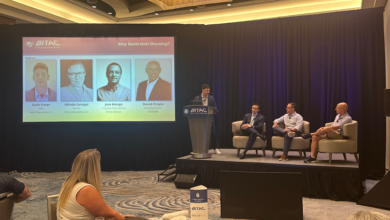
SCOTTSDALE, Ariz. — Casino and resort operators are trying to solve a complicated equation: how to use technology, automation and AI to relieve staffing pressure and drive revenue without weakening the guest experience. Drawing from their own real-world success stories, a panel of leading gaming executives shared their insights on modern-day casino operations with attendees at BITAC Casino & Resort 2026, held June 7-9 at The Phoenician in Scottsdale, Ariz.
The session, “Casino Operations Today — and the Forces Shaping Tomorrow,” was moderated by Cody Adent, president of Vibrant Management. He was joined by:
- Randy Beck, director of category management, facilities and horticulture at MGM Resorts International
- Steve Neely, chief marketing officer of Quechan + Paradise Casinos
- Doug Searle, general manager and chief operating officer of Naskila Casino in Livingston, Texas
For a little more than 35 minutes, the three executives traced a single theme through staffing, design, marketing and artificial intelligence: how to deploy technology against repetitive work while protecting the human touchpoints of the guest experiences that distinguish one property from another.
Starting with the Right People
Adent jumpstarted the discussion by asking the panelists to name a past decision they would handle differently. The executive shared more lessons in people and process than outright mistakes.
For Beck, having the right team at the table was crucial. He described a current issue involving exterior environmental services work in Las Vegas, saying the lack of early involvement from frontline managers created problems after contracts were awarded. The takeaway, he said, was making sure the right stakeholders are involved in the RFP processes from the start.
Neely offered a different spin on the question: “I don’t think I’ve made mistakes; I think I’ve learned lessons.” He added that his own missteps came from extending too much latitude to underperformers.
“It’s all about the people you surround yourself with, and holding them accountable, and giving them the tools they need to do their work,” he explained.
Searle, who is now opening his fourth gaming facility, said his biggest regret came during an earlier opening, when he did not bring in human resources and training director early enough.
His fix: “Build your operations around HR and training.”
Responding to a Changing Economy
A session on casino operations wouldn’t be complete without a look at the current economic impacts and how gaming facilities are adapting.
Beck reported that MGM Resorts has seen pressure in Las Vegas visitation over the past six to nine months.
“There’s not as many sporadic people saying, ‘Hey, let’s take a three-day weekend, go to Las Vegas, take Monday off,’” Beck said.
He cited a significant decline in “mid-level visitations,” particularly during the Tuesday-through-Thursday period. In response to the dip, Beck said MGM has been looking at all-inclusive packages that combine room, food and shows to bring more people into Las Vegas.
He also pointed to entertainment and family-focused amenities as part of the strategy. In addition to the Bob Marley production “Hope Road” and a “Friends” exhibit, investments have been made to renovate the arcades at New York-New York and Excalibur.
Balancing Tech and Human Service
Labor resources are always a hot topic in hospitality, and with the implementation of new staffing technologies, the industry is navigating a full-blown workforce transformation. Neely said many tribal properties that he has worked with face staffing challenges because they are located in remote or hard-to-hire markets. That has pushed operators to look for technology that can reduce labor needs while maintaining service.
Among the tech that Neely has implemented at some of his properties: Robots that run dirty dishes back to the dish room so servers can bus their own tables and keep their tips, and dealer-assist table games that he rotated slot attendants through. At one casino, he combined the cage and the players club into a single 24-hour operation.
And while he also cited self-serve kiosks and app-based check-ins as examples of tools operators have used to improve efficiency, he also warned that technology must be used carefully.
“The overall objective is to reduce labor, but you don’t want to do it at the expense of guest experience,” he said. Kiosks, by contrast, remain inconsistent; he described a recent self-check-in experience as so frustrating that “I would have rather to have gone to the dentist.”
Eliminating human employees carries a cost, he said, taking aim at large Strip operators that he said cut positions chiefly to satisfy Wall Street rather than to improve service. The better use of technology, he said, is to deepen contact with the guest. He offered as an example slot-dispatch alerts that prompt staff to greet a guest by name or acknowledge their birthday.
“There’s a delicate balance, but I’ve had a lot of success with technology and using it in a positive way,” Neely said.
Designing From Back of House Forward
When it comes to designing a successful casino resort, guest retention is paramount; however, during the panel discussion, Searle made a compelling case that resort design should begin where guests never go.
“You have to start from back of house and then work your way to the front of house,” he said.
Searle explained that during the early design stages operators need to think through trash handling, maintenance, the employee dining room (EDR) and storage – areas that he said architects routinely shortchange.
“We [need to] build and design our EDR for our team members that makes them feel like they’re a guest,” Searle said.
From there, Searle took a look at the design considerations of the cash-cage operations, which he said are “probably the single most important part of what happens in a casino” because they affect how money moves from the gaming floor to count rooms and back to the vault. For “volume-related shops,” Searle stressed that it’s necessary for a slot floor to be laid out so that jackpot payouts are made in less than five minutes.
Before opening day, Searle said his teams pressure test the wayfinding so there are no bottlenecks in a facility. They also run full mockups in all the restaurants with chefs and sommeliers.
“We’re testing wine, we’re trying out new foods, we’re cooking the menus,” he said. “We’re making sure everything happens before the day one operations happen.”
And long before it’s time to open the doors, Searle said a team needs to think about the first impression guests will have as they approach the property. For the Alabama-Coushatta Tribe of Texas, Naskila’s owner, Searle said the entry road is being designed to evoke the tribe’s historical migration from Alabama to Texas. The roadway design will segue into the facility’s cultural display, which Searle called “something people have never seen before.”
High Touch vs. High Tech
Returning to the questions surrounding high-touch luxury service and increased automation, Neely linked the high-touch service to data. Cash recyclers and dispensers, he said, removed chronic bottlenecks and counting errors at Rolling Hills Casino during a staffing shortage, freeing employees for guest-facing work.
He explained that he makes sure his staff knows the guests they’re serving.
“Every guest is important. Some are more valuable,” he said.
Tech helps with that, he said. Neely said he uses a handheld dispatch tool that can provide a player’s name, tier level, average daily theoretical (ADT) and length of stay even before an interaction. He offered a segmentation that landed in the room: “The noisiest customers in the building are the ones that are the least valuable, or the most valuable. The ones in the middle don’t say a lot; they speak with their feet.”
For Beck, he sees AI as a tool for “busy work.” MGM runs automated floor scrubbers and a robot that has restored the company’s parking garages.
“You got to make sure you still face-to-face with your guests,” he said. “You got to balance that AI and what that [guest] interaction is going to look like.”
Neely, who said he came up through marketing, argued that the industry underuses AI as a marketing weapon. At a previous property, he said, automated calls and texts alerted guests to fresh offers and nudged loyalty-program members toward incomplete gift sets. It was all work that was handled by an AI partner that he identified as Imagine This. The incremental lift on such reminders, he said, runs “somewhere around 15% to 20%” with no added staff effort.
He also described geofencing neighboring competing properties to gauge share of wallet.
“I tell my hosts all the time, ‘Your customers have more money to spend with you. The other people are just giving them a better reason to go see them instead of seeing you, and I have the data to support it,’” he said. “The ability to go on offense with AI is unbelievable.”
Who’s at the Digital Front Door?
In a world where most of us are tethered to our mobile devices, an app is often plays a key role in the guest experience. Searle said a property’s app is now its “digital front door,” a project he begins by drafting a guiding document with marketing leadership and an agency before selecting a third-party vendor. His ambition is a “wow factor” — voice-driven, conversational app responses that route guests to dining, the pool, the spa or a planned 3,000-seat entertainment venue.
Both Beck and Neely made the case for disclosure: Guests need to know they’re communicating with an automated assistant. Beck recounted a call from an HVAC vendor that was so lifelike that he realized it only afterward that he had been speaking with an automated system.
“It’s important [guests] also know they’re talking to AI,” he said.
Neely said guests at Casino del Sol in Tucson grew so attached to the property’s AI assistants that they named them. Staff even wore T-shirts bearing the assistants’ likenesses. He likened it to the film “Her” while stressing the need for transparency.
When asked which channel works best, Neely said it varies by guest, but he said calls and voicemails remain important in gaming. “They say, ‘Well, text me, don’t call me.’ OK, then they don’t reply to your text, but when they do answer your call or listen to your voicemail,” he said.
“We’re still in the human business,” Neely said. “And we lose sight of that from time to time.”
One Change in 12 months
In a sort of lightning-round Q&A, panelists were asked: What change hotel or casino operators should consider in the next 12 months? Searle was quick with an answer: “Redo the rooms.”
Searle said properties need to ensure guestrooms keep pace with guest expectations, including technology that works. He offered the example of a malfunctioning charger and a damaged fixture in his room during a recent stay.
Neely focused on employee empowerment.
“Push the decision — the approval level — to the furthest level on the floor that you can,” Neely said.
He gave the example of a server who spills a drink on a guest. If the server is empowered to resolve the situation immediately, Neely said, it may be a small problem. If it escalates to management, it becomes more expensive and more difficult.
“Allow the people in the battle to make battlefield decisions,” he said, adding a test for managers: “Do you have a single employee on your staff that you don’t trust with 20 bucks to make a $20 decision? If you do, get rid of that person.”
Beck said MGM uses a similar approach through a program called “Say Yes,” which empowers line staff to resolve issues immediately. He also echoed Searle on deferred renovations, warning that small maintenance lapses compound quickly.
From the Audience: OTAs and More
An audience Q&A steered the close of the session toward outside forces. One attendee called online travel agencies (OTAs) “the trillion-dollar animal that’s in the room,” warning that better-funded players such as Expedia could capture AI-driven bookings before they reach properties’ direct channels. It was, he said, his “biggest fear that keeps me up at night.”
Neely’s response: “Manage your business. Don’t be managed.” A second attendee offered two countermeasures: third-party services that audit OTA billing nightly for overcharges, and using call centers to capture an OTA guest’s contact information for direct marketing.
A final questioner noted his company had deployed AI technology to dozens of properties in 90 days and asked how operators will move guests toward adoption. Neely urged patience, recalling a cashless-gaming rollout at Rolling Hills shortly after the pandemic that he called “a tragic failure” because guests were not ready. New technologies tend to emerge slowly before gaining broad acceptance, he said, and casino operators are now testing which tools guests are ready to use.
His guidance for getting there was a tried-and-true adage of the industry: “Listen to what your guests show you.”

![Shahid Javed[1]](https://hotelinteractive.com/wp-content/uploads/2023/05/Shahid-Javed1-scaled-390x220.jpg)