April 9, 2026 | From the Hotel Interactive Newsroom
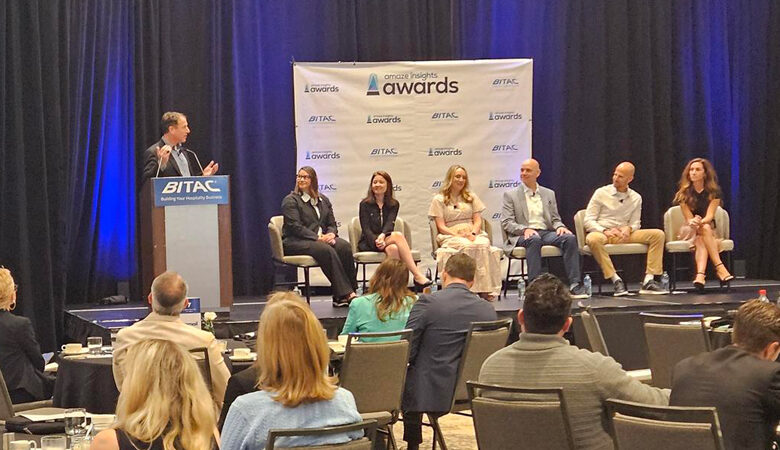
Leaders from throughout the hospitality industry flocked to Fort Myers, Fla., March 29-31 for the 2026 BITAC® Sales, Marketing & Revenue Management Summit. Monday’s first panel discussion featured the honorees of Sunday night’s Amaze Insights Awards, which recognized individuals who had made “a transformative and positive impact in the industry.” Nick Horgan moderated the session that brought together:
- Ashley Asher, senior director of sales, Columbia Hospitality
- Stephanie Atkisson, SVP of commercial strategies, Raines Company
- Jamie Grittman, head of commercial strategy, Welcome Group
- Brian Krail, group VP, commercial operations and sales strategy, Wyndham Hotels & Resorts
- Lior Sekler, chief commercial officer, HRI Hospitality
- Kiley Watkins, director of digital marketing & strategy, Island Hospitality Management
At a moment when hospitality companies are navigating labor pressure, technology acceleration and continued pressure to grow without diluting brand identity, the session centered on what leadership looked like in practice. The conversation did not land on abstract ideas about inspiration or culture for culture’s sake. Instead, it examined the operational decisions that shape how companies scale, recruit, retain and compete. The executives on stage described a version of leadership that is centered on people, disciplined execution and a willingness to adapt without losing sight of hospitality’s mission.
Culture, Talent and the Long Game
For Asher, that started with culture. Reflecting on nearly 14 years with Columbia Hospitality, she said the company’s entrepreneurial structure had made it feel “almost as if I’ve worked and Columbia Hospitality has been a startup over and over.” She described the organization’s expansion across multiple verticals, including residential, golf, consulting, conference centers and owned assets, noting that the challenge had become preserving what made the company distinct in the first place. Growth brought complexity. But for Asher, it also brought a greater obligation to protect the internal culture that sustained performance. She said the concern came from the top, citing founder and Chairman John Oppenheimer’s worry about “the loss of culture” as the company kept growing.
Asher tied that concern to management practice. She viewed culture as a crucial function of coaching, training, mentoring and creating the kind of shared experiences that keep teams aligned and engaged. She pointed to recent in-person internal meetings as examples of how the company reinforced that connection. According to Asher, those gatherings, which brought together sales, revenue management and marketing leaders, were part of how the company has maintained continuity and reinforced expectations across a growing portfolio. Asher said in a time of virtual teams and rapid expansion, culture can’t be an afterthought; it has to be front and center in how the organization operates.
Horgan then turned the discussion to Atkisson, who focused on impact through talent strategy. At Raines Company, they’re broadening the hiring pipeline by working with CarolinaLIFE, a program for students with intellectual and developmental disabilities at the University of South Carolina. According to Atkisson, the partnership has already changed the makeup of the workforce at one property where more than 30% of the hotel staff has a disability.
The partnership with CarolinaLIFE “is very instrumental in changing the way that our team is looked at,” she said. “That’s been really transformative for finding new talent.”
For operators confronting persistent staffing challenges, the Raines Company example illustrates how a company could build a more stable workforce by rethinking where it looks for talent and how it structures opportunities.
Partners Over Pitches
As business development and vendor relationships formed another thread in the discussion, Horgan handed off to Grittman, the longtime buyer on the panel, for her advice to suppliers who are looking to connect with large management companies. Grittman explained that access to management companies, especially smaller or newer ones, depended on credibility, referrals and long-term alignment, rather than the hard sell.
“I go back to relationships,” she said. “I don’t do business with somebody I don’t know.”
To build these types of productive connections, Grittman advises using shared relationships, seeking warm introductions and approaching the conversation as the beginning of a partnership rather than a transaction. Establishing a collaborative relationship is crucial, she said, because many operators are sorting through crowded technology categories and competing solution sets. Grittman said smaller management companies often need to move quickly to build out systems and infrastructure, but they do not necessarily need the flashiest product in the market.
“They may not have the best technology solution, but they’re going to be good partners,” she said. “And if it’s not going to be a partnership, it won’t work.”
Where AI Actually Fits
Technology talk segued directly into Krail’s take on artificial intelligence and how Wyndham Hotels & Resorts is incorporating it in a layered operational strategy that’s built around different stakeholders. With roughly 8,000 hotels globally and an ownership base made up largely of small, independent operators, Krail explained that Wyndham had to think carefully about where standardization helped and where it didn’t. He said to determine where AI fit into Wyndham’s strategy, the company considered the perspectives of three groups: internal/corporate employees, guests and hotel owners.
Krail said rather than committing wholesale to a single provider, Wyndham looked for partners that already understood specific business functions and were using AI to strengthen existing tools. That approach let the company test and expand capabilities without overcomplicating the experience for end users. As an example, Krail offered the company’s Canary partnership and the launch of Wyndham Connect, an AI-powered guest-engagement tool for messaging and service interactions.
“As a guest, you will not know that you’re interacting with AI,” he said. That lack of friction was central to the value proposition, he said. The technology supported responsiveness and personalization without forcing the guest to confront the mechanics behind it.
Wyndham applied the same logic to AI applications for the owners. Krail described tools that allowed franchisees to search for brand standards and operational guidance through conversational prompts rather than static portals. The result, he said, was improved speed and usability, cutting brand-standard question responses by about 94%. The real-time access to information reduces the administrative drag for owners and operators who need answers fast. It was another example of a growing pragmatic view of AI in hospitality: AI can assist staff with routine processes and free them to focus on higher-value work, but it is not a replacement for human judgment or service.
‘A Career, Not a Job’
Sekler brought the conversation back to humans in hospitality, specifically in leadership structure and retention. When it comes to hiring at HRI Hospitality, he said the company looks for “somebody who’s looking for a career, not a job.” He illustrated that philosophy citing HRI’s tenure profile: The average tenure within its commercial services runs between nine and 13 years. Sekler attributes this to an “employee/associate centric” environment in which the company invested in people and allowed room for professional development.
He described his own career path to illustrate his point. Sekler said when he was recruited into a newly created role at HRI, the blank-canvas nature of the job had been part of the appeal, so he moved to New Orleans. When he realized the Crescent City wasn’t a good fit for him personally, the company allowed him to work remotely — unheard of in 2012. In retrospect, that decision signaled an early sign of management flexibility. It shows retention is often built through responsiveness, trust and a willingness to adjust traditional structures when the talent is worth keeping.
As the discussion circled around systems, workforce models and business strategy, it kept coming back to temperament. Watkins simply stated that she aims to bring positivity and presence to both work and home.
“There’s so many things that you can’t control, but you can control your mindset,” she said. “And you can control, like, just being kind.”
What sounded like personal reflection was really a management approach. In a service business defined by constant unpredictability, emotional steadiness and genuine engagement aren’t soft skills; rather, they influence team culture, guest experience and a leader’s credibility.
Building on Watkins’ point, Asher shared that the best advice she had ever received was early in her career: “Cooler heads prevail.” Asher explained that her first job at the Westin Seattle, every issue coming across the desk felt urgent because in hospitality, problems often arrive framed as emergencies. Keeping calm and distinguishing between noise and genuine risk is a key management skill. It takes a calm head to respond without escalating tension, and it remains critical across commercial, operational and guest-facing roles.
Krail picked up that theme in a different way when asked what had kept him at Wyndham for 19 years. He said he had never once left work feeling he had compromised his integrity, and throughout his career, he’d had the opportunity to work in different roles that offered a variety of experiences and perspectives. He urged the audience to take calculated risks in a business where experimentation rarely carries life-or-death stakes.
“You can roll the dice on it, and be like, ‘You know what? I think this is going to work. I have a 10% confidence level,” he said. “Roll the dice at 10%. You tried. Who regrets anything that they tried? It’s always the regret that you didn’t.”
Krail wasn’t advocating recklessness; he was reminding hospitality leaders and vendors that they often have more room to experiment, learn and adapt than they think. As the market continues to respond to rapid shifts in consumer behavior, rising operating costs and evolving demands in tech, being willing to act quickly can give you a competitive edge.
As the panel discussion concluded, a working model had emerged — not a vision statement. The Amaze Insights Awards the night before had set the stage for a conversation that offered hospitality leaders actionable insights. The executives on stage weren’t offering theory; rather, they were describing what’s actually working inside their organizations right now: growing portfolios without losing culture, widening the labor pool through inclusive hiring, using AI where it solves real problems and leading with enough steadiness to keep moving when conditions aren’t ideal.
Those themes resonated at a moment when the industry is still navigating uneven staffing, a crowded technology landscape and shifting guest expectations. The panelists offered a working model of leadership that connects people strategy, operational discipline and adaptability. For operators trying to scale without losing their footing, that’s about as practical as it gets.
***
Interested in speaking at a future event? To learn more about speaking opportunities, connect with the BITAC team here.
Follow BITAC Events on LinkedIn, Instagram and TikTok for event updates and highlights.