March 18, 2026 | From the Hotel Interactive Newsroom
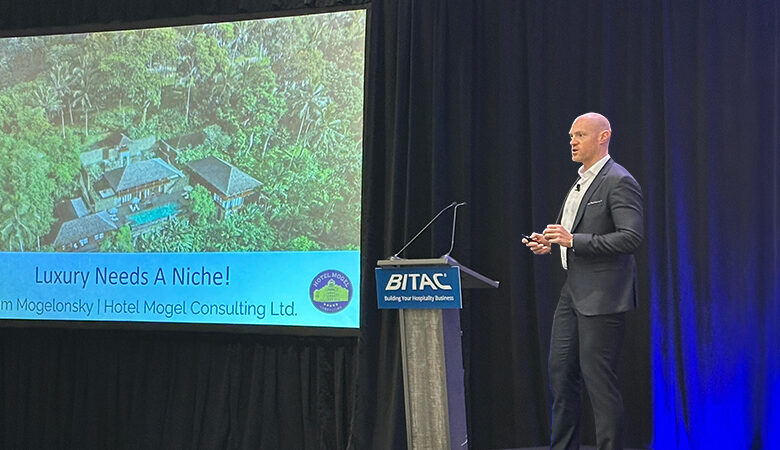
At BITAC Luxury 2026, held Feb. 22-24 at the Naples Grande Beach Resort in Naples, Fla., hospitality strategist Adam Mogelonsky delivered a clear message to hotel owners and developers: In luxury, the middle ground is gone. Speaking during the event’s keynote session, he made the case that simply calling a property “luxury” is no longer enough in a market where hundreds of hotels routinely charge more than $1,000 a night.
“You have to define a niche,” he told the audience. “You have to be more than just luxury.”
Mogelonsky, whose firm Hotel Mogel Consulting advises owners and developers, based his keynote on data and case studies from around the world. He says he and his team are tracking hotels that consistently charge at least $1,000 per night — and now count more than 500 such properties globally, with rates at some properties stretching to $2,000, $3,000 or even $10,000.
He compared that growth at the top of the market with slower performance in other chain scales, where he says operators are struggling to grow average daily rate and improve gross operating profit. At the same time, major global hotel companies are dividing the upper tier into ever finer categories: luxury, super luxury, ultra-luxury, “uber” luxury and beyond.
“There’s a split in how these categories are being defined,” he said, predicting the language and definitions will settle over the next decade.
Mogelonsky attributed the surge in high-rate luxury demand to three forces he believes will continue shaping development decisions: the experience economy, baby boomer wealth and the growing sentiment that “health is wealth.”
Guests, he said, are increasingly willing to live modestly at home while funneling discretionary income into big-ticket trips and stays. “They may live in a one-bedroom apartment in New York City, but they’re spending thousands of dollars on that once-in-a-lifetime trip,” he said.
Boomers, after decades of asset growth, can now spend “like crazy” on these trips, he added. In addition to being able to pay for luxury travel is a growing willingness to pay for wellness, longevity and preventative care while traveling.
Mogelonsky told the audience that the properties performing best in this environment have three things in common: a defined niche, a coherent story that touches every part of the guest experience and a willingness to invest in capital improvements that support that positioning.
The Room as its Own Resort
On the design side, he highlighted the enduring influence of ultra-low-density resorts that fuse privacy, landscape and architecture. Recalling early Aman properties as models of scarcity and exclusivity, he noted how a low key count and generous room footprints became selling points rather than constraints.
“The idea here is that it’s not just about the resort,” he said. “You should have complete privacy. Your own room is a resort unto itself.”
In contrast, heritage urban hotels are finding success by leaning into age and patina. Mogelonsky cited long-established European properties that preserve original furniture and architectural details through successive renovations instead of replacing them wholesale. He described one historic hotel where 125-year-old lobby chairs have been reupholstered and reworked multiple times, maintaining a physical connection across generations of guests.
“It’s not just a renovation to bring it up to modern standards,” he said. “They go, ‘How can we preserve so people feel like they’re coming into a place that has all this love, all this heritage?’ Everything carries forward.”
Art can also serve as a point of distinction, he said, particularly when collections render each room unique and turn corridors and public spaces into informal galleries. When backed by investment in serious pieces, that “maximalist” approach, he said, encourages guests to linger and creates an atmosphere closer to a private house or museum than a standardized hotel.
Bathrooms, meanwhile, are becoming “mini-spas” in their own right, he said. Rather than forcing guests to budget two hours for a traditional spa visit, some luxury properties are installing elements such as steam showers, infrared booths and other wellness fixtures in-room. In Europe, he noted, several resorts have gone further by theming bathrooms differently from room to room, giving repeat guests a reason to return and request a new configuration.
Beyond Bricks and Mortar
Shifting from design and amenities, Mogelonsky challenged attendees to think of their properties as communities rather than static assets. He said one wellness-focused Caribbean resort has built such a strong sense of community that its average length of stay now exceeds a week, and many guests have returned every year or two for decades. He cited customer surveys at the property that consistently show that the top reason for returning is “the other guests.”
“In their key markets — like New York, Toronto, London — they have meetup groups where [recurring guests] get together for dinners,” he said. “Because they became friends there” at the resort.
Programming for children deserves the same level of thought as adult wellness and dining, according to Mogelonsky. He offered as examples resorts that combine hands-on local crafts, sports instruction and supervised animal encounters with basic education around topics such as skincare. Those experiences, when tailored to the destination, can entertain younger travelers and create an attachment to the brand or property that can last into adulthood.
Urban properties, he added, can also stand out through programming, particularly when they secure exclusive access to nearby institutions or artisans. He described hotels that partner with museums and historic libraries to offer after-hours tours for guests, as well as others that host on-property workshops in traditional crafts linked to local history. Mogelonsky says the hook for these on-property experiences is exclusivity: “You have to stay there to have those experiences.”
Culinary Excellence and ‘Cultural Exchange’
Mogelonsky says a property’s food and beverage operations are no longer just a matter of culinary excellence. He said dining should be treated as a “cultural exchange” and an opportunity to tell the story of the land. He pointed to the rise of “agri-luxury,” or farm hospitality, in which production agriculture becomes part of the guest experience, and to hotels building programming around a single culinary specialty, such as wine, chocolate, coffee or beer. He described a converted monastery in Spain that pairs vineyard activities and tastings with private dining in the former refectory and a serious art collection.
Mogelonsky also introduced what he called “agrobiodiversity,” an emerging term in F&B that he believes could become increasingly important as hotels look for ways to carve out a niche. As he described it, modern supply chains rely on a narrow range of crops and genetic variants. Resorts that source from local farms that grow lesser-known varieties or heritage strains and then put those ingredients at the center of menus and spa rituals can support more resilient food systems while differentiating their offerings.
In his view, that kind of thinking feeds into a broader shift from sustainability toward “regenerative travel.” The goal, he said, is to “up level the land” and local culture through thoughtful development and ongoing operations.
Redefining ‘Wellness’
Mogelonsky sees rapid change in the definition of “wellness” in luxury. He noted that by 2026, a hotel that calls itself luxury but lacks a credible wellness offering “is no longer luxury.” Sleep-focused room design, air quality, noise control and post-workout recovery tools are now taken seriously by guests paying top-end rates, he said.
One urban lifestyle brand in New York has built its flagship hotel around sleep and performance, according to Mogelonsky. Mattresses are selected to support temperature control, rooms are heavily soundproofed, and lighting is designed to stay low near the bed. In-room “room bars” offer collagen coffee, Epsom salts, face masks and aromatherapy as substitutes for the sugary snacks and liquor that once dominated minibars. Guest rooms also include basic recovery equipment to complement the brand’s fitness offerings downstairs.
On the West Coast, he said, a separate brand has condensed that thinking into dedicated “fitness rooms” that come with Peloton bikes, yoga setups and percussive massage devices. The logic is simple: Business travelers might only have 20 minutes between commitments, and they are far more likely to exercise if the bike or mat is already in their room.
Meanwhile, “touchless” wellness technologies — such as infrared saunas, high-tech loungers and sound therapy pods — are changing spa economics. Device-based services, he said, can help hotels keep spa revenue growing as the supply of practitioners shrinks, driven in part by corporations hiring wellness staff directly and more therapists launching private in-home businesses.
Throughout the keynote, Mogelonsky emphasized that no single trend or case study offers a turnkey solution. Instead, he encouraged owners and operators to “mix and match” ideas and work with branding partners to choose a path they can commit to fully.
“Not everything here applies to you,” he said in closing. “But whatever path you choose … work with your branding agencies to figure out that one path, really drive it home, and understand where the general trends of luxury are going — and where the general trends of where luxury travel is going. And then together, you’ll have a great product that will bring value to your guests and bring value to your owners.”
***
Interested in speaking at a future event? To learn more about speaking opportunities, connect with the BITAC team here.
Follow BITAC Events on LinkedIn, Instagram and TikTok for event updates and highlights.
Jacqui Barrineau is editor at Hotel Interactive, an online trade publication featuring event recaps and curated news stories on developments, trends and thought leaders in the hospitality industry.